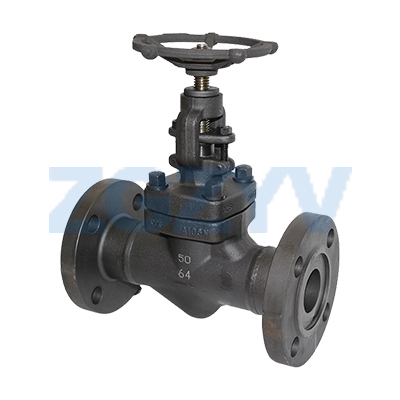
Interpretation of the core characteristics of forged steel globe valves
Forged steel globe valve is an industrial grade valve made of forged steel, which cuts off or connects fluids in pipelines like a switch. It drives the valve stem by rotating the handwheel, causing the valve disc (a metal plug) to move up and down, pressing or leaving the valve seat, thereby achieving fluid on/off control.
Below we will explain the characteristics of forged steel globe valves for you:
1. Forged steel → means stronger
Compared to cast valves, forging process is like repeatedly pounding metal, making the internal structure tighter, able to withstand high pressure (such as power plant steam pipelines), high temperature (up to 550 ℃), and less prone to cracking.
2. Cut off valve → specialized switch, not good at adjusting
The forged steel globe valve has good sealing performance (the valve disc is tightly pressed and the valve seat is tightened like a bottle cap), fast switching (short stroke), and durability (the sealing surface is not easily worn). But due to the high fluid resistance (many bends in the pipeline), it is not possible to fine tune the flow rate.
3. Special design to cope with extreme environments
Bellows version: The valve stem is fitted with a bellows, which completely prevents leakage and is suitable for toxic and flammable media.
Self sealing valve cover: The higher the pressure, the tighter the seal, specializing in high-pressure pipelines.
This type of valve is specialized in heavy work, with the core principle being: press it down to cut off the flow, lift it up to ensure smooth operation. Suitable for small-diameter pipelines, high temperature and high pressure scenarios, and leak prevention situations.