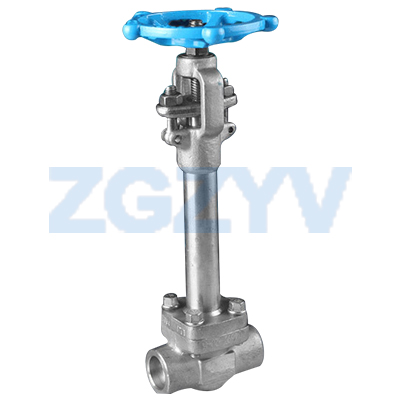
Why does forged steel gate valve produce noise during operation?
The noise generated during the operation of forged steel gate valves is mainly caused by fluid dynamics and mechanical vibration.
Fluid dynamics noise is the main cause:
1. Turbulent noise
When the fluid flows through the narrow channel of the valve seat, the flow velocity increases sharply, forming high-frequency turbulent vortices, and pressure fluctuations produce broadband noise (concentrated at 1000-8000Hz)
Trigger condition: When the valve opening is less than 30%, the pressure difference suddenly rises and the flow rate exceeds the critical value.
2. Cavitation/cavitation noise (unique to liquid media)
The liquid in the local low-pressure area vaporizes to form bubbles, and when the high-pressure area collapses, a shock wave is generated, emitting a sharp explosive sound (peak value up to 10000Hz).
Judgment mark: There is a “rustling” metal flushing sound accompanied by vibration in the pipeline behind the valve.
3. Fluid impact noise
The sudden change in the flow direction of the medium (such as a 90 ° turn of an angle gate valve) impacts the valve body, causing a low-frequency roar (<500Hz) due to momentum conversion.
Mechanical vibration noise:
1. Valve core vibration
Uneven fluid forces cause the valve core to shake laterally and collide with the valve seat. There is a regular ‘click’ sound.
2. Valve stem vibration
Unstable driving of the actuator or resonance induced by transmission clearance. Continuous buzzing sound appears.
3. Valve body resonance
The external pipeline vibration frequency is coupled with the natural frequency of the valve body. There is a severe overall tremor accompanied by a roar.