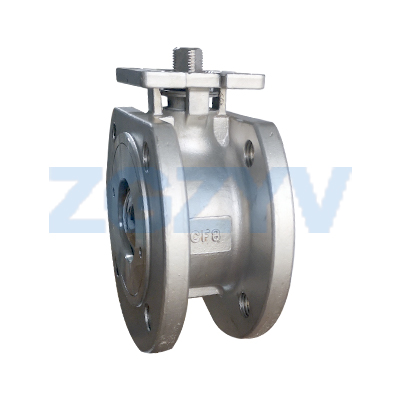
How to deal with installation errors of stainless steel ball valves?
If the stainless steel ball valve is installed incorrectly, it may lead to seal failure, medium leakage, and even safety accidents! Therefore, timely measures need to be taken to respond.
Identify directionality and reinstall:
Check if the valve body has flow direction markings (such as arrows). If it is a one-way sealed ball valve (such as a V-shaped ball valve or an eccentric hemispherical valve), disassemble it and reinstall it in the correct direction; If it is a bi-directional sealed ball valve (such as an O-ring ball valve), there is no strict requirement for direction. Ensure that the valve is in the closed position during installation, and align the flange or threaded connection with the pipeline to avoid stress deformation.
Perform sealing test:
After reinstallation, perform a pressure test: close the valve, apply a tightness test of 1.1 times the nominal pressure, maintain the pressure for no less than the specified time, and observe whether the pressure gauge is stable. If the pressure drops, it indicates internal leakage and the sealing surface needs to be checked for wear or impurities stuck.
Debugging and functional verification:
Operate the valve switch, feel whether the force is uniform, and confirm that the actuator (such as handwheel or pneumatic device) moves flexibly. If there is a checkpoint, it is necessary to lubricate the valve stem or remove internal impurities; If the feedback signal is abnormal, calibrate the limit switch or check the control circuit.
After processing, regularly check the valve status to avoid repeated errors. Wear protective equipment during operation to ensure a safe working environment.