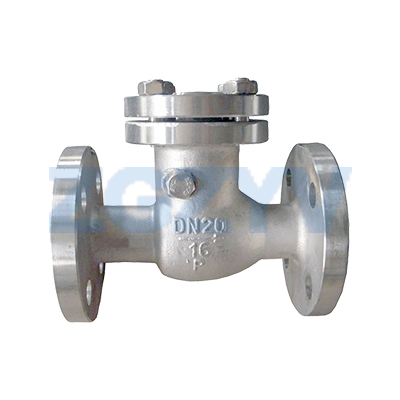
Methods for troubleshooting stainless steel check valves
The faults of stainless steel check valves should be systematically investigated from three aspects: sealing failure, abnormal opening and closing, and structural damage.
Seal leakage is common due to wear of the sealing surface or aging of the gasket. It is recommended to replace the 316L stainless steel sealing component and use PTFE reinforced gaskets. Valve disc blockage is often caused by foreign objects blocking or guide pin wear. It is necessary to disassemble, inspect, clean the valve chamber, and replace the hardened guide pin.
For valve body cracks under high pressure conditions, the machine should be stopped immediately to replace the forged steel valve body that meets the GB/T12235 standard. The backflow problem caused by improper installation requires recalibration of the valve body axis to ensure a horizontal deviation of ≤ 2 ° from the pipeline, and synchronous inspection of whether the support spacing between adjacent pipe sections meets the requirement of 1.5 times the pipe diameter.
Standardized procedures should be established for operation and maintenance:
Verify flexibility by manually opening and closing 20 times a month, conduct quarterly testing of sealing surface roughness (Ra ≤ 1.6 μ m), inject high-temperature resistant silicone grease during annual maintenance, and conduct a 1.5 times working pressure test. It is recommended to install pressure sensors at key nodes to monitor pressure fluctuations in real-time and automatically sound an alarm when the pressure difference exceeds 0.05MPa.