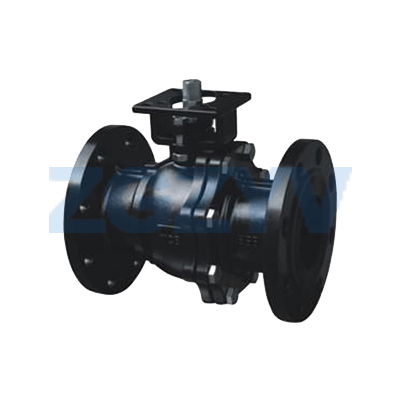
How to choose the model of cast steel ball valve? Details here!
Model selection of cast steel ball valves requires comprehensive consideration of multiple factors such as working condition parameters, media characteristics and system requirements, which together constitute the key basis for ensuring reliable operation of the valve.
Floating ball valve with its simple structure and excellent sealability has become the first choice of medium-low pressure system, this design by medium pressure to push the spherical pressure valve seat to achieve sealing, especially suitable for working pressure below 4.0MPa. The fixed ball valve adopts a bearing support structure, can withstand high pressure impact of up to 32.0MPa, the rigidity of its upper and lower valve rod reduces the operating torque by more than 30%, which shows obvious advantages in large-diameter pipeline systems.
For low-pressure systems such as urban water supply and drainage, the PN16 specification has been able to meet the demand; while petrochemical plants usually require high-pressure valves above PN25, and even ultra-high-pressure models such as PN40 need to be selected in extreme scenarios such as deep well oil extraction. Temperature adaptability is equally critical, the upper temperature limit for ordinary cast steel ball valves is 425 ℃. When the medium temperature exceeds this limit, high-temperature resistant models of special heat treatment processes must be used, such as T6 heat-treated WCB material valves, which can increase their high-temperature strength by more than 40%.
When conveying corrosive media, the valve body material should be upgraded to CF8M stainless steel, with the addition of its molybdenum element to increase its corrosion resistance by 5 times; for sludge containing solid particles, the combination of a V-type ball valve and a carbide valve seat is required. This configuration can effectively prevent particle blockage. The application case of a mining enterprise shows that this scheme extends the valve life from 3 months to more than 2 years. Food and pharmaceutical grade applications must meet 3-A hygiene standards, requiring all contact surface roughness below Ra0.4μm, and use non-toxic sealing materials.
The pneumatic actuator response time can be controlled in 0.5 seconds, especially suitable for emergency interlocking systems that require quick cutting, but need to be accompanied by an air treatment unit to keep the air source dry. The electric ball valve can achieve precise flow regulation, its 4-20mA signal control accuracy can reach ±1%, which is an obvious advantage in the central control system.
Soft seal valves use PTFE or reinforced PTFE valve seats to achieve bubble-grade sealing at normal temperature, but performance drops sharply above 200 ℃; metal hard seals achieve high temperature sealing through spherical contact with the line of the valve seat, although the initial leakage rate is high (about 50ml / min), but can meet the ANSI Class V standard after 200 opening and closing grinding.