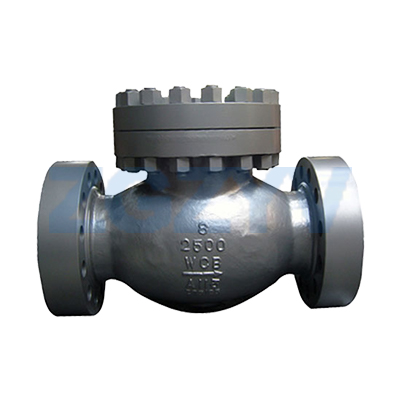
What should I do if there is a loud noise from the cast steel check valve?
The noise of cast steel check valves is mostly related to medium flow, component collision, or structural adaptation problems. Following its working logic to prevent backflow, the cause can be found.
Firstly, we need to address the issue of medium flow:
A check valve relies on the pressure of the medium to open the valve disc, and the valve disc resets and closes when it flows back. If the flow rate of the medium in the pipeline is too fast, such as the head of the water pump being too high or the diameter of the pipeline being smaller than the valve, turbulence will form when the medium rushes through the gap between the valve disc and the valve seat, just like the sound of water rushing into a narrow pipe. Turbulence will repeatedly impact the valve body and the inner wall of the valve disc, emitting a continuous buzzing sound. If there is still air mixed in the medium, bubbles will burst or collide with the valve disc inside the valve, and there will be a hissing noise added.
Then there is the “collision problem” between the valve disc and the valve seat:
This is a common source of noise in check valves. When a check valve is closed, the valve disc is either reset by gravity (such as a swing type) or by a spring (such as a lift type). If the closing speed is too fast, the valve disc will bang violently against the valve seat, producing a water hammer like impact sound. Especially for swing type check valves, the valve disc itself is heavier, and when the medium flows back, the valve disc will lose pressure support and quickly fall down, with greater impact force and louder noise. There is also a situation where the valve disc or seat has been worn out for a long time, causing scratches and deformation on the sealing surface. When the medium flows through, it will leak through the gaps, and the leaked medium will impact the valve disc in reverse, causing the valve disc to bounce back and forth on the valve seat, producing high-frequency vibration noise that sounds like a continuous sizzling sound, and the more it leaks, the more obvious the noise becomes.
Looking at the issue of installation and selection again:
If the check valve is selected too small, for example, if the actual flow rate of the pipeline is greater than the rated flow rate of the valve, the medium will squeeze through the valve, and the flow velocity will be forced to increase, resulting in increased turbulence noise; Or the installation position may be incorrect, such as being installed at the highest point of a horizontal pipeline, which can easily accumulate gas. When gas and liquid mix and flow, gas-liquid two-phase flow will form, and bubbles will collide with the valve disc and valve body, resulting in much higher noise than when pure liquid flows. Also, the installation was not fixed properly, and the connection between the valve and the pipeline was not secure. During operation, the valve itself will vibrate with the flow of the medium and the movement of the valve disc, and the vibration will be transmitted to the pipeline, causing the pipeline to hum together. This noise is not only from the valve itself, but also becomes structural resonance noise, which sounds more dull and has a wider range.
In addition, the issue of springs cannot be ignored:
A check valve that relies on a spring for reset, if the spring elasticity is not adjusted properly and the elasticity is too large, the valve disc will require greater medium pressure to open. After opening, the spring will remain in a tight state, and when closing, the spring will suddenly contract, pushing the valve disc hard against the valve seat and increasing the impact noise; The elasticity is too small, and the valve disc does not close in time. When the medium flows back, the valve disc will first move back a little, and then be pulled back by the spring. During this process, the valve disc will “shake” inside the valve, causing multiple light collisions with the valve body or seat, resulting in intermittent noise. If the spring itself is worn, deformed, and has uneven elasticity, the movement of the valve disc will be even more unstable, sometimes fast and sometimes slow, and the noise will become fluctuating, even producing piercing high-frequency sounds.
Finally, there are fluctuations in the working conditions of the medium:
For example, the pressure or flow rate in the pipeline frequently changes, such as the frequent start and stop of the water pump, frequent opening and closing of other valves, and the medium pressure fluctuating between high and low. The valve disc will repeatedly open and close, in an unstable motion state. For example, when the pressure is just enough to push open the valve disc, it will soon drop again, the valve disc will close back a little, and then the pressure will rise and open again. These frequent small actions will cause the valve disc and valve seat to constantly rub and collide, and the flow state of the medium will also repeatedly become chaotic. The noise will continue to fluctuate, and this fluctuation will accelerate the wear of the valve disc and valve seat. Over time, the noise will become more and more serious.