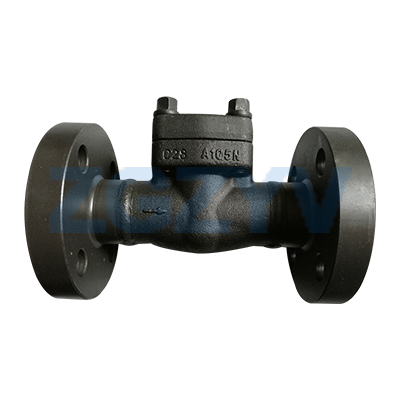
The most important thing is the suitable forged steel check valve!
How to choose a suitable forged steel check valve? It should be carried out in combination with the actual working conditions and the adaptability of the valve core performance!
Firstly, it is necessary to clarify the characteristics of the medium in the application scenario (such as gas, liquid, whether it contains particles or corrosive components), working temperature, and pressure range, to ensure that the rated pressure, temperature resistance level, and medium compatibility of the selected valve meet the requirements of the working conditions. For example, when transporting corrosive media, attention should be paid to whether the forged steel valve body has undergone special anti-corrosion treatment. In high-temperature working conditions, it is necessary to confirm whether the valve sealing surface material can withstand the sealing stability at high temperatures. Next, it is necessary to select the corresponding interface check valve based on the connection method of the pipeline system (such as threads, flanges, welding) to ensure compatibility with the pipeline installation and avoid installation difficulties or seal failure caused by inconsistent connection forms. It is also necessary to consider the structural type of the valve. Different structures of forged steel check valves (such as lift and swing) are suitable for different scenarios. Lift type valves have better sealing performance and are suitable for small caliber and low-pressure scenarios, while swing type valves have strong flow capacity and are more suitable for large caliber and high-pressure working conditions. It is necessary to determine which structure can better meet the efficiency and stability requirements of the system for backflow prevention based on the pipeline diameter, flow requirements, and installation space size.
In addition, it is necessary to pay attention to the sealing performance and service life of the valve, and check whether the sealing surface material (such as hard alloy, soft sealing material) matches the characteristics of the medium to avoid sealing failure caused by medium wear or corrosion. At the same time, products with high purity forged steel material and standard processing accuracy should be selected to ensure that the valve body strength is sufficient to withstand long-term working pressure, reduce failures caused by material defects, and ultimately achieve the reliable function of check valves in pipeline system backflow protection.